IPTables uses the filter table to act as a firewall, but it also controls the routing of packets on Linux.
A table in IPTables is a collection of chains for a particular networking function.
- Filter Table (Firewall)
- Input Chain
- Output Chain
- Forward Chain
- NAT Table
- Output Chain
- Prerouting Chain
- Postrouting Chain
- Mangle Table
- Input Chain
- Output Chain
- Forward Chain
- Prerouting Chain
- Postrouting Chain
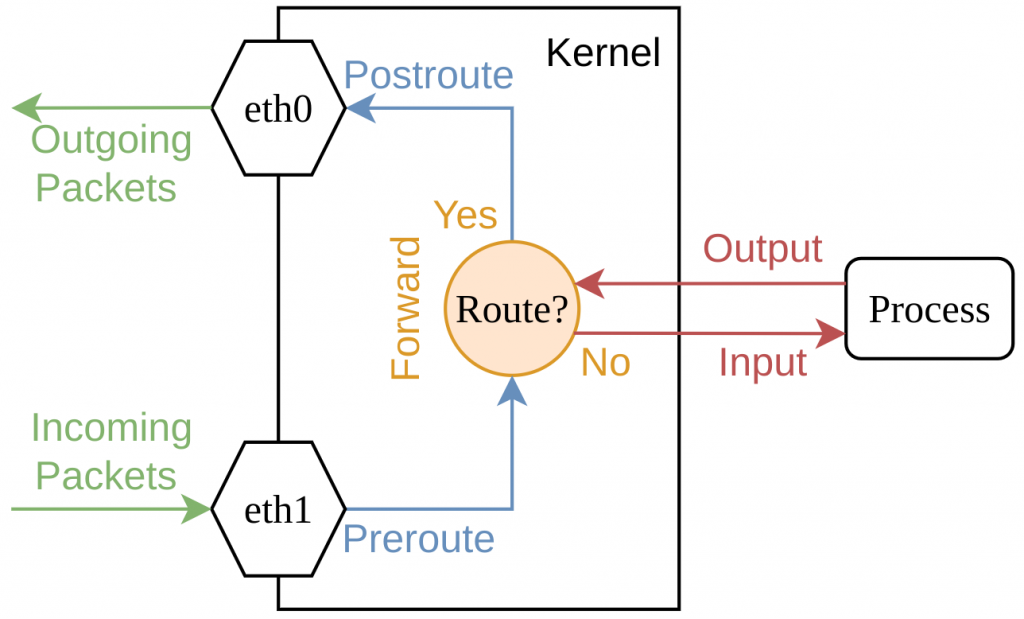
Chains match packets based on their state. Here is a simplified view of the main chains:
COMMANDS
- iptables -L
- List rules.
- iptables -L –line-numbers
- List rules with line numbers.
- iptables -D INPUT
- Delete a rule from the INPUT chain.
- iptables -F
- Flush all rules.
- iptables –policy INPUT ACCEPT
- Set the default policy to ACCEPT.
- iptables –policy INPUT DROP
- Set the default policy to DROP.
- iptables -I -s 1.1.1.1 -j ACCEPT
- Insert a rule at the top.
- Allows connections from the specified IP.
- iptables -A -s 1.1.1.0/24 -j DROP
- Append a rule to the end.
- Drops connections from the specified network.
- iptables -I INPUT -p tcp –dport 80 -j DROP
- Block incoming connections to a port.
- iptables -I OUTPUT -p tcp –dport 443 -j DROP
- Drop outgoing packets to a destination port.
- sudo iptables -t nat -L -n -v –line-numbers
- List all rules in the NAT table with line numbers.
- sudo iptables -t nat -D PREROUTING 10
- Delete rule number 10 from the NAT table PREROUTING chain.
- iptables -I INPUT -p tcp –dport -j REJECT –reject-with tcp-reset
- Helps prevent port enumeration by sending a TCP reset instead of silently dropping the packet, making scan results less accurate.
Chain traversal for incoming traffic:
- PREROUTING -> INPUT
- Inbound traffic destined for the host.
- PREROUTING -> FORWARD -> POSTROUTING
- Traffic being routed through the host.
- PREROUTING -> OUTPUT -> POSTROUTING
- Outbound traffic originating from the host.
CREATE PERSISTENCE
sudo /sbin/iptables-save | sudo tee /root/iptables-rules.v4
sudo apt install iptables-persistent -y
Alternatively, create the file /etc/rc.local and add your rules:
#!/bin/bash
sudo iptables -t nat -A PREROUTING -i ens5 -p udp --dport 1144 -j DNAT --to 10.8.0.2:1144
sudo iptables -t nat -A PREROUTING -i ens5 -p tcp --dport 49152:49159 -j DNAT --to 10.8.0.2:49152-49159
exit 0
FLUSHING ALL TABLES AND DELETING ALL CHAINS
sudo iptables -t filter -F
sudo iptables -t filter -X
sudo iptables -t mangle -X
sudo iptables -t mangle -F
sudo iptables -t raw -X
sudo iptables -t raw -F
sudo iptables -t security -X
sudo iptables -t security -F
sudo iptables -t nat -X
sudo iptables -t nat -F
REFLECTIONS
Older versions of UFW only evaluated INPUT and OUTPUT chains, but the latest version blocks FORWARD traffic by default unless manually allowed.
sudo nano /etc/ufw/before.rules
Add the following lines before COMMIT to allow forwarding to a specific subnet:
-A FORWARD -d 192.168.10.0/24 -j ACCEPT
-A FORWARD -s 192.168.10.0/24 -j ACCEPT
To allow forwarding of all packets:
sudo sed -i 's/^DEFAULT_FORWARD_POLICY="DROP"/DEFAULT_FORWARD_POLICY="ACCEPT"/' /etc/default/ufw